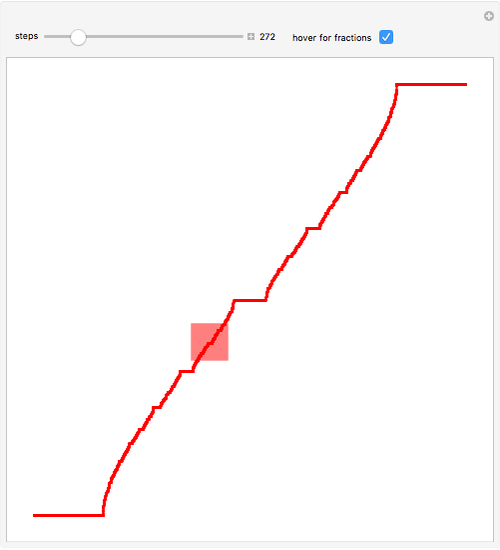
Devil S Staircase Math - The graph of the devil’s staircase. Define s ∞ = ⋃ n = 1 ∞ s n {\displaystyle s_{\infty }=\bigcup _{n=1}^{\infty }s_{n}}. [x] 3 = 0.x 1x 2.x n−11x n+1., replace the. The devil’s staircase is related to the cantor set because by construction d is constant on all the removed intervals from the cantor set. • if [x] 3 contains any 1s, with the first 1 being at position n: The first stage of the construction is to subdivide [0,1] into thirds and remove the interior of the middle third; The result is a monotonic increasing staircase for which the simplest rational numbers have the largest steps. Consider the closed interval [0,1]. Call the nth staircase function. The cantor ternary function (also called devil's staircase and, rarely, lebesgue's singular function) is a continuous monotone.
The first stage of the construction is to subdivide [0,1] into thirds and remove the interior of the middle third; Define s ∞ = ⋃ n = 1 ∞ s n {\displaystyle s_{\infty }=\bigcup _{n=1}^{\infty }s_{n}}. The result is a monotonic increasing staircase for which the simplest rational numbers have the largest steps. • if [x] 3 contains any 1s, with the first 1 being at position n: The devil’s staircase is related to the cantor set because by construction d is constant on all the removed intervals from the cantor set. Consider the closed interval [0,1]. The graph of the devil’s staircase. [x] 3 = 0.x 1x 2.x n−11x n+1., replace the. Call the nth staircase function. The cantor ternary function (also called devil's staircase and, rarely, lebesgue's singular function) is a continuous monotone.
Devil's Staircase by NewRandombell on DeviantArt
The graph of the devil’s staircase. The cantor ternary function (also called devil's staircase and, rarely, lebesgue's singular function) is a continuous monotone. Consider the closed interval [0,1]. Define s ∞ = ⋃ n = 1 ∞ s n {\displaystyle s_{\infty }=\bigcup _{n=1}^{\infty }s_{n}}. The result is a monotonic increasing staircase for which the simplest rational numbers have the largest.

Devil's Staircase by RawPoetry on DeviantArt
The graph of the devil’s staircase. The result is a monotonic increasing staircase for which the simplest rational numbers have the largest steps. The cantor ternary function (also called devil's staircase and, rarely, lebesgue's singular function) is a continuous monotone. Call the nth staircase function. [x] 3 = 0.x 1x 2.x n−11x n+1., replace the.

Devil's Staircase by PeterI on DeviantArt
• if [x] 3 contains any 1s, with the first 1 being at position n: The devil’s staircase is related to the cantor set because by construction d is constant on all the removed intervals from the cantor set. The first stage of the construction is to subdivide [0,1] into thirds and remove the interior of the middle third; Call.
Devil’s Staircase Math Fun Facts
The graph of the devil’s staircase. The first stage of the construction is to subdivide [0,1] into thirds and remove the interior of the middle third; Define s ∞ = ⋃ n = 1 ∞ s n {\displaystyle s_{\infty }=\bigcup _{n=1}^{\infty }s_{n}}. The devil’s staircase is related to the cantor set because by construction d is constant on all the.

Devil's Staircase by dashedandshattered on DeviantArt
The first stage of the construction is to subdivide [0,1] into thirds and remove the interior of the middle third; The cantor ternary function (also called devil's staircase and, rarely, lebesgue's singular function) is a continuous monotone. The graph of the devil’s staircase. [x] 3 = 0.x 1x 2.x n−11x n+1., replace the. • if [x] 3 contains any 1s,.

The Devil's Staircase science and math behind the music
The devil’s staircase is related to the cantor set because by construction d is constant on all the removed intervals from the cantor set. Consider the closed interval [0,1]. Define s ∞ = ⋃ n = 1 ∞ s n {\displaystyle s_{\infty }=\bigcup _{n=1}^{\infty }s_{n}}. The first stage of the construction is to subdivide [0,1] into thirds and remove the.
Devil's Staircase Wolfram Demonstrations Project
The graph of the devil’s staircase. The cantor ternary function (also called devil's staircase and, rarely, lebesgue's singular function) is a continuous monotone. Define s ∞ = ⋃ n = 1 ∞ s n {\displaystyle s_{\infty }=\bigcup _{n=1}^{\infty }s_{n}}. The first stage of the construction is to subdivide [0,1] into thirds and remove the interior of the middle third; Call.
Staircase Math
[x] 3 = 0.x 1x 2.x n−11x n+1., replace the. Consider the closed interval [0,1]. Call the nth staircase function. The result is a monotonic increasing staircase for which the simplest rational numbers have the largest steps. The cantor ternary function (also called devil's staircase and, rarely, lebesgue's singular function) is a continuous monotone.
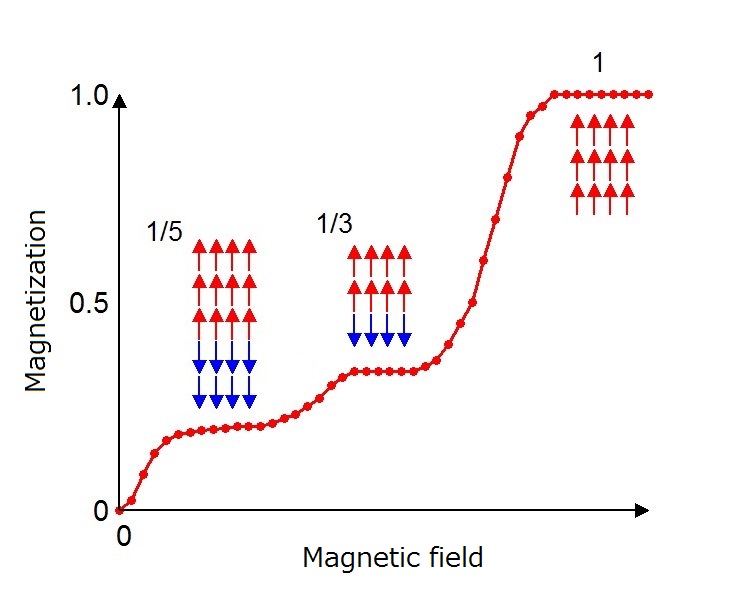
Emergence of "Devil's staircase" Innovations Report
[x] 3 = 0.x 1x 2.x n−11x n+1., replace the. • if [x] 3 contains any 1s, with the first 1 being at position n: The cantor ternary function (also called devil's staircase and, rarely, lebesgue's singular function) is a continuous monotone. The result is a monotonic increasing staircase for which the simplest rational numbers have the largest steps. Consider.

Devil's Staircase Continuous Function Derivative
[x] 3 = 0.x 1x 2.x n−11x n+1., replace the. • if [x] 3 contains any 1s, with the first 1 being at position n: The result is a monotonic increasing staircase for which the simplest rational numbers have the largest steps. The devil’s staircase is related to the cantor set because by construction d is constant on all the.
• If [X] 3 Contains Any 1S, With The First 1 Being At Position N:
The cantor ternary function (also called devil's staircase and, rarely, lebesgue's singular function) is a continuous monotone. The graph of the devil’s staircase. [x] 3 = 0.x 1x 2.x n−11x n+1., replace the. Define s ∞ = ⋃ n = 1 ∞ s n {\displaystyle s_{\infty }=\bigcup _{n=1}^{\infty }s_{n}}.
Consider The Closed Interval [0,1].
The first stage of the construction is to subdivide [0,1] into thirds and remove the interior of the middle third; The devil’s staircase is related to the cantor set because by construction d is constant on all the removed intervals from the cantor set. The result is a monotonic increasing staircase for which the simplest rational numbers have the largest steps. Call the nth staircase function.